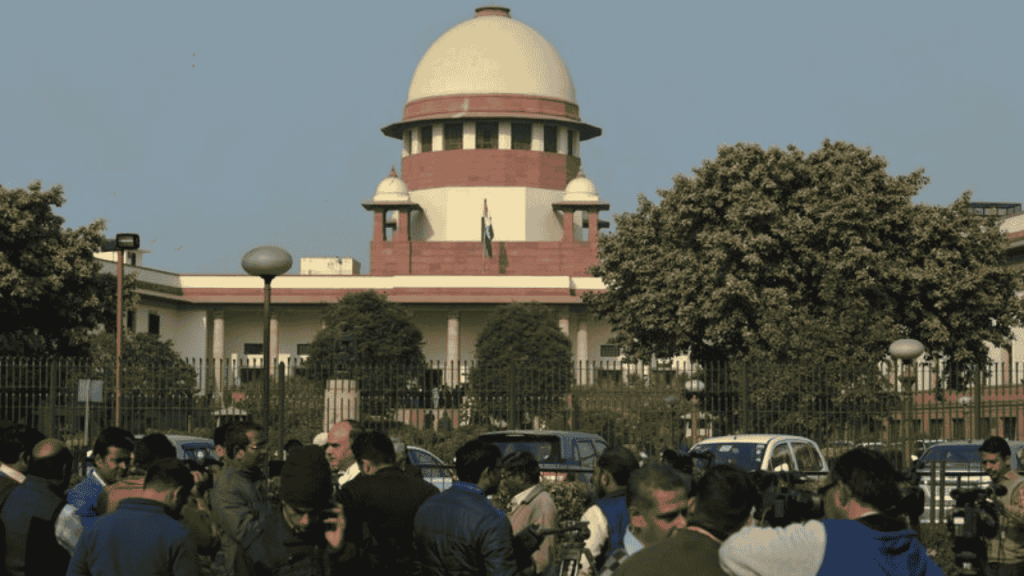
In a strong message against nepotism and favoritism in public institutions, the Supreme Court of India has cancelled the allotment of two super deluxe flats made by a Haryana government housing society to a governing body member and his subordinate. Calling the act a “gross abuse of powers and authority,” the apex court ruled that such conduct strikes at the heart of democratic values.
The judgment was delivered by a Bench comprising Justice Sanjay Kumar and Justice K Vinod Chandran of the Supreme Court of India. The court not only set aside the controversial allotments but also overturned an earlier decision of the Punjab and Haryana High Court, which had declined to interfere in the matter.
Table of Contents
Strong Words Against Nepotism in Public Institutions
The court observed that nepotism and self-aggrandisement are “anathema to a democratic system,” particularly when such acts occur within organizations formed by government employees to provide housing facilities through transparent procedures.
The housing society in question, the HUDA, Urban Estate and Town and Country Planning Employees Welfare Organisation (HEWO), was established to provide housing benefits to eligible members through a fair and structured allotment process. However, the apex court found that this very purpose was undermined when preferential treatment was extended to individuals who did not meet the prescribed eligibility criteria.
According to the ruling, one of the beneficiaries was not even eligible as he had failed to complete the mandatory six-month deputation period in the service of the Haryana Urban Development Authority (HUDA). Despite this, he received preferential allotment of a super deluxe flat.
High Court Decision Overturned
Earlier, the Punjab and Haryana High Court had refused to interfere with the allotment. It reasoned that since an earlier allotment to a governing body member had been surrendered and re-allotted, and since the subordinate had obtained his flat through a draw of lots in which the petitioner also participated, the petitioner was barred from challenging the process.
However, the Supreme Court rejected this reasoning. It held that participation in a draw of lots does not legitimize an arbitrary or illegal allotment. If the foundational process itself is flawed and violates eligibility norms, subsequent participation cannot cure the defect.
The Bench made it clear that fairness and transparency are non-negotiable when it comes to public housing schemes involving government employees.
Petition Filed by Dinesh Kumar
The case reached the Supreme Court through a petition filed by Dinesh Kumar, a member of HEWO. Kumar contended that the allotment of the two super deluxe flats was arbitrary and violated the society’s own eligibility criteria.
The apex court found merit in his claims. It noted that Kumar had applied pursuant to the advertisement issued by the society and was fully eligible under the prescribed conditions. He satisfied both the deputation period requirement and the basic pay criteria, making him a legitimate contender.
In contrast, the court found no justification for the preferential treatment given to the governing body member. “There could have been no preferential allotment,” the Bench stated firmly, adding that the act amounted to clear favoritism.
Refund Order and Eviction Direction
As part of its verdict dated February 17, the Supreme Court ordered that the amounts deposited by the third and fourth respondents for the flats be refunded within one month without interest. Additionally, the beneficiaries have been directed to vacate the premises within one month of receiving the refund.
The court’s decision ensures that the improperly allotted flats return to the housing society for lawful redistribution according to established norms.
Heavy Costs Imposed
To underline the seriousness of the misconduct, the court also imposed financial penalties on multiple parties involved in the irregular allotment.
HUDA has been directed to pay costs of Rs 1 lakh. The third respondent must pay Rs 50,000, while the fourth respondent has been ordered to pay Rs 25,000. Furthermore, the second respondent must pay Rs 50,000 to the petitioner as litigation expenses.
The remaining costs are to be deposited with the Legal Services Committee of the Supreme Court within two months. This move reinforces the court’s stance that misuse of authority in public bodies will attract consequences.
Final Conclusion
The Supreme Court’s decisive action in cancelling the allotment of two super deluxe flats stands as a powerful reminder that abuse of authority will not be tolerated. By striking down preferential treatment and reinforcing eligibility norms, the court has reaffirmed its commitment to fairness, transparency, and democratic values.